COST
COST Action B 14
HYPERBARIC OXYGEN THERAPY
FINAL EVALUATION REPORT
Period: from December 1998 to March 2005
� Overview
Action Identification Data
COST Action B14 Hyperbaric Oxygen Therapy
TC Recommendation: First MC meeting: 19 March 1999
CSO Approval: 25 June 1998 Last MC meeting: 4 December 2004
Start date: 9 December 1998 Final Report: 10 March 2006
Duration: 60 months Evaluation Report:
Extension: 15 months TC Evaluation:
End date: 8 March 2005
Number of signatories: 19
Signatories and date of signature:
Austria: 9 December 1998 Greece: 18 December 1998 Poland: 9 March 1999
Belgium: 9 December 1998 Hungary Portugal: 26 April 1999
Bulgaria Iceland Romania
Croatia Israel: 19 December 2000 Slovakia
Cyprus: 17 July 2001 Ireland Slovenia: 9 December 1998
Czech Rep: 12 May 2000 Italy: 5 May 1999 Spain: 13 January 1999
Denmark: 9 December 1998 Latvia Sweden: 24 February 1999
Estonia Lithuania Switzerland: 9 December 1998
Finnland : 9 June 1999 Luxembourg Turkey
France: 8 March 2000 Malta United Kingdom:
Germany: 9 December 1998 Netherlands: 10 February 1999 9 December 1998
Institutes of non-COST countries:
Area: Medicine and Health
Action Web site : http://www.oxynet.org
Chairperson : Professor Daniel MATHIEU
Professor D. MATHIEU Tel : 333 20 44 54 91
Centre Régional Hyperbare Fax : 333 20 44 43 17
CHRU de Lille E-Mail : dmathieu@chru-lille.fr
Bd du Pr. Leclercq
F-59307 Lille Cedex
TC Rapporteur :
External Evaluator :
External Evaluator :
‚ Objectives
Hyperbaric Oxygen Therapy (HBOT) is a treatment modality using oxygen breathed under high pressure. The expected therapeutic benefits are: increase in diffusion of oxygen into tissues adjacent to the microcirculation and thus, the survival of cells otherwise insufficiently oxygenated, generalised arteriolar vasoconstriction, anti-infectious effects, promotion of healing.
Introduced in the medical therapeutic armament in the early sixties, HBOT has been widely used before its development became restrained by an insufficient pathophysiological knowledge and some technical concerns.
The main objective of the Action is to improve the knowledge required for a rational use of HBOT, to a level making it possible to set out specific guidelines for the implementation and development of clinical HBOT centres and to provide scientifically sound recommendations for HBOT treatment of various diseases and conditions.
� Technical description and implementation
The COST Action B14 « Hyperbaric Oxygen Therapy » is managed for all its official aspects by a Management Committee which is responsible for the determination of the overall strategy, approval of working group reports and decisions, attribution of short term scientific missions, official reports and meeting organisation.
As proposed in the MoU, the COST B14 Action has been implemented through 3 working groups (WG) devoted to the development of :
- a « Information Network », to be maintained throughout the duration of the Action. It consists in an Internet Website, allowing the easy retrieval of information, the participation to discussion groups and the consultation of a bibliographic database pertinent to HBOT (WG A). In this frame, a study was performed. The aim of the study was : “Collecting, indexing and analysis of all relevant publications at the European level on Hyperbaric Oxygen Therapy and setting up a database”.
- a « Research Guidance Document » specifying the quality criteria desired for any new and ongoing research projects on HBOT, based on the analysis of existing research data and of the weight of the available scientific data (WG B).
- a « Research Priority Report », defining areas needing further clarification urgently, that will serve as a basis for directed clinical and experimental research (WG C). After having completed its task, this working group has launched 5 specific research teams devoted to one of the selected topics:
- Working group 1 : Sudden deafness
- Working group 2 : Femoral head necrosis
- Working group 3 : Oncology
- Working group 4 : Diabetic foot lesions
- Working group 5 : Technical aspects of HBOT
Later on, this last one was reshaped in an other form as Working group on “Safety aspects of HBOT”
Due to the administrative and financial difficulties of the COST program, only 2 meetings with a limited number of participants could be organised in 2002 and no meeting at all for the first semester of 2003. If the clinical studies already launched have moderately suffered from this fact, the other activities of the COST action B14 have been slowed down. In order to achieve the goals assigned to the action B14 in the MoU, prolongation requests have been issued and agreed.
A reflection about the future cooperation in the field of Hyperbaric oxygen Therapy once the COST action B14 finished, has been initiated by the Management Committee. Two main topics emerged: education and hyperbaric oxygen therapy in intensive care patient. In order to pursue the reflection, 2 new working groups has been designed , the first one “ Education” with a project of an European educational network in hyperbaric medicine, the second “ HBO and Intensive Care” with a research project on the specificities in physiologic and pathophysiologic responses of intensive care patient in HBO.
„ Participation and co-ordination
4.1 Management Committee
Chairperson : Pr. D. MATHIEU
Professor in Intensive Care Medicine - Université de Lille II
Service d’Urgences Respiratoires, de Réanimation
Médicale et de Médecine Hyperbare
Hôpital Calmette
CHRU de Lille
F.59037 Lille Cedex
Tel : +33-3-20.44.54.91
Fax : +33-3-20.44.50.94
E-mail :dmathieu@chru-lille.fr
Vice chairperson : Dr. P. GERMONPRE
Center for Hyperbaric Oxygen Therapy
Military Hospital Queen Astrid
Bruynstraat 200
B-1120 Brussels
Tel : +33-2-264.48.68
Fax : +33-2-264.48.61
E-mail : peter.germonpre@smd.be
Secretary : Pr. M. PASCU
DG Research / B5 - COST Secretariat
Rue de la Loi 200 ; Office: SDME 9/76
B-1049 Brussels
Tel: +32-2-299 15 56
Fax: +32-2-296 42 89
E-mail: mihail.pascu@cec.eu.int
LIST OF NOMINATED MEMBERS AND OBSERVERS
AUSTRIA
Institut für medizinische Physiologie
Medizinischen Fakultät
Unversitât Wien
Universitätsklinik für Anästhesie und Intensivmedizin
Ludwig Boltzmann-Institut für Anästhesie und Intensivmedizin
Wien
BELGIUM
Dr. Peter GERMONPRE
Center of Hyperbaric Oxygen Therapy
Military Hospital Queen Astrid
Brussels
Center for Hyperbaric Oxygen Therapy
Military Hospital Queen Astrid
Brussels
CYPRUS
Dr Sotiris GEORGHIOU
Diving and Hyperbaric Department
Larnaca General Hospital
Larnaca
CZECH REPUBLIC
Dr Jiri RUZICKA
Charles University
Medical Faculty of Plzen
Pilsen
DENMARK
H.S Rigshospitalet
Anætesi-og operationsklinikken
København
H:S Rigshospitalet
Anætesi-og operationsklinikken
København
FINLAND
Head of Intensive Care Unit for Adults
Dept of Anesthesia and Intensive Care
University Central Hospital
Turku
Pr. Juha NIINIKOSKI
Professor of Surgery and Chairman
Department of Surgery
University Central Hospital
Turku
FRANCE
Pr. Daniel MATHIEU
Hôpital Calmette - CHRU
Service d’Urgence Respiratoire, de Réanimation Médicale
et de Médecine Hyperbare
Lille
Hôpital Salvator - AP-HP
Service de réanimation de médecine hyperbare
Marseille
GERMANY
Aerztlicher Direktor des HBO-Zentrums
Rhein-Neckar
Diakonissenkrankenhaus Mannheim
Mannheim
Diakoniekrankenhaus
Klinik für Strahlentherapie
Radioonkologie und Nuklearmedizin
Rotenburg / Wümme
GREECE
Hyperbaric Department Director
“ST. PAUL’S” General Hospital
Thessaloniki
Naval Hospital of Athens
Dept. of Hyperbaric Oxygen
Athens
ISRAEL
Dr. Yehuda MELAMED
Elrom Hacarmel Ltd Hyperbaric Medical Center
Haifa
ITALY
Dr. Pasquale LONGOBARDI
Centro iperbarico SRL
Ravenna
Dr. Monica ROCCO
Policlinico Umberto I
Istituto di Anestesiologia e Rianimazione
Roma
POLAND
Institute of Maritime and Tropical Medicine
National Center of Hyperbaric Medicine
Gdynia
Dr. Jacek KOT
Institute of Maritime and Tropical Medicine
National Center of Hyperbaric Medicine
Gdynia
PORTUGAL
Hyperbaric Medical Centre
NAVY Hospital
Lisboa
Dr. Antonio Cesar GATA SIMAO
Hyperbaric Medical Centre
NAVY Hospital
Lisboa
SLOVENIA
Baromedical Centre
Ljubljana
SPAIN
Dr. Jordi DESOLA
CRIS – Unitat de Terapeutica Hiperbarica
Hospital Cruz Roja
Barcelona
Dr. Francisco RIOS
CIMA
Arturo Soria 82
Madrid
SWEDEN
Div. of Hyperbaric Medicine
Dept. of Anesthesiology and Intensive Care
Karolinska Hospital
Stockholm
Pr. Dr. Gosta GRANSTRÖM
Dept. of Otolaryngology
Sahlgrenska University Hospital
Göteborg
SWITZERLAND
Foundation for Hyperbaric Medicine
Kleinhüningerstrasse 177
Basel
Dr Daniel BLICKENSTORFER
Segantinistr. 71
Zürich
THE NETHERLANDS
Afdeling Radiotherapie, sectie Radiobiologie
Faculteit der Geneeskunde - Vrije Universiteit Medisch Centrum
Amsterdam
Dr. A.J. VAN DER KLEIJ
Academic Medical Center
Department of Surgery
Amsterdam
UNITED KINGDOM
Chairman of Drugs and Therapeutic Committee
Whipps Cross University Hospital
London
4.2 Participating Institutions
4.3 Meetings of the Management Committee
1) 1999, March 19th : Brussels, Belgium
2) 1999, September 25th : Düsseldorf, Germany
3) 1999, December 10th : Amsterdam, The Netherlands
4) 2000, March 24th-25th : Copenhagen, Denmark
5) 2000, September 30th : Ravenna, Italy
6) 2001, April 19th -21st : Gdynia, Poland
7) 2001, December 13th-15th : Ljubjana, Slovenia
8) 2002, April 18th -20th : Thessaloniki, Greece
9) 2002, October 19th : Prague, Czech Republic
10) 2003, September 20th : Barcelona, Spain
11) 2004, May 8th : Turku, Finland
12) 2004, December 2nd,4th : Lille, France
4.4 Meetings of the Working Groups
- Meetings of Working Group A : « Information Network »
1) 1999, March 19th : Brussels, Belgium
2) 1999, September 25th : Düsseldorf, Germany
3) 1999, December 10th : Amsterdam, The Netherlands
4) 2000, March 24th-25th : Copenhagen, Denmark
5) 2000, June 17th : Gdynia, Poland
6) 2000, September 28th : Ravenna, Italy
7) 2001, April 19th : Gdynia, Poland
8) 2001, December 13th : Ljubjana, Slovenia
9) 2002, April 18th : Thessaloniki, Greece
10) 2002, October 17th : Prague, Czech Republic
11) 2003, September 18th : Barcelona, Spain
12) 2004, May 6th : Turku, Finland
13) 2004, December 2nd : Lille, France
Final Report approved by Management Committee, the 2nd of December, 2004.
- Meetings of Working Group B : « Research Guidance Document »
1) 1999, March 19th : Brussels, Belgium
2) 1999, September 25th : Düsseldorf, Germany
3) 1999, December 10th : Amsterdam, The Netherlands
Final Report approved by Management Committee, the 11th of December, 1999.
- Meetings of Working Group C : « Research Priority Report »
1) 1999, March 19th : Brussels, Belgium
2) 1999, September 25th : Düsseldorf, Germany
3) 1999, December 10th : Amsterdam, The Netherlands
4) 2000, March 24-25th : Copenhagen, Denmark
Final Report approved by Management Committee, the 25th of March, 2000.
- Meetings of Working Group 1 : « Sudden Deafness »
1) 2000, March 25th : Copenhagen, Denmark
2) 2000, June 13th : Marseille, France
3) 2000, September 29th : Ravenna, Italy
4) 2001, April 20th : Gdynia, Poland
5) 2001, October 18th : Lisbon, Portugal
6) 2001, December 14th : Ljubjana, Slovenia
7) 2002, April 19th : Thessaloniki, Greece
8) 2003, September 19th : Barcelona, Spain
9) 2004, May 7th : Turku, Finland
10) 2004, December 1st : Lille, France
Final Report approved by Management Committee, the 2nd of December, 2004.
- Meetings of Working Group 2 : « Femoral Head Necrosis »
1) 2000, September 9 th : Vicenza, Italy
2) 2000, December 16 th : Vicenza, Italy
3) 2002, April 19th : Thessaloniki, Greece
4) 2002, October 17th-18th: Prague, Czech Republic
5) 2003, September 19th: Barcelona, Spain
6) 2003 December 6th : Brussels, Belgium
7) 2004, May 7th : Turku, Finland
8) 2004, December 1st : Lille, France
Final Report approved by Management Committee, the 2nd of December, 2004.
- Meetings of Working Group 3 : « Oncology »
1) 2000, March 25th : Copenhagen, Denmark
2) 2000, September 2nd : Hamburg, Germany
3) 2000, September 29th : Ravenna, Italy
4) 2000, November 24th-25th : Lisbon, Portugal
5) 2001, April 20th : Gdynia, Poland
6) 2001, December 14th : Ljubjana, Slovenia
7) 2002, April 19th : Thessaloniki, Greece
8) 2002, October 17th-18th : Prague, Czech Republic
9) 2003, September 18th-19th: Barcelona, Spain
10) 2004, May 6th-7th : Turku, Finland
11) 2004, December 1st : Lille, France
Final Report approved by Management Committee, the 2nd of December, 2004.
- Meetings of Working Group 4 : « Diabetic foot lesions »
1) 2000, March 25th : Copenhagen, Denmark
2) 2000, June 3rd : Brussels, Belgium
3) 2000, September 29th : Ravenna, Italy
4) 2000, December 16th : Brussels, Belgium
5) 2001, April 20th : Gdynia, Poland
6) 2001, December 14th : Ljubjana, Slovenia
7) 2002, April 19th : Thessaloniki, Greece
8) 2002, October 18th : Prague: Czech Republic
9) 2003, September 19th : Barcelona, Spain
10) 2004, May 7th : Turku, Finland
11) 2004, December 1st : Lille, France
Final Report approved by Management Committee, the 2nd of December, 2004.
- Meetings of Working Group : « Technical Aspects of HBOT »
1) 2000, March 25th : Copenhagen, Denmark
2) 2000, April 11th : Brussels, Belgium
3) 2000, June 30th-July 1st : Barcelona, Spain
4) 2000, September 29th : Ravenna, Italy
5) 2000, November 17th-18th : Brussels, Belgium
6) 2001, February 2nd-3rd : Paris, France
7) 2001, April 19th-20th : Gdynia, Poland
Final Report approved by Management Committee, the 20th of April, 2001.
- Meetings of Working Group : « Safety aspects of HBOT »
1) 2001, April 20th : Gdynia, Poland
2) 2001, September 12th : Hamburg, Germany
3) 2001, December 14th : Ljubljana, Slovenia
4) 2002, March 22nd-23rd : Paris, France
5) 2001, April 19th : Thessaloniki, Greece
6) 2002, September 4th : Brugge, Belgium
7) 2002, October 17th-18th : Prague, Czech Republic
8) 2003, August 28th : Copenhagen, Denmark
9) 2003, September 18th-19th: Barcelona, Spain
10) 2003, December 5th-6th : Brussels, Belgium
11) 2004, May 6th-7th : Turku, Finland
12) 2004, December 1st : Lille, France
Final Report approved by Management Committee, the 2nd of December, 2004.
- Meetings of the Working Group : “ Education and training in Hyberbaric Medicine ”
1) 2004, May 5th : Turku, Finland
2) 2004, September 15th : Ajaccio, France
3) 2004, December 1st : Lille, France
Final Report approved by Management Committee, the 2nd of December, 2004.
- Meetings of the Working Group : “ Intensive Care in HBO ”
1) 2004, May 6th : Turku, Finland
2) 2004, September 16th : Ajaccio, France
3) 2004, December 2nd : Lille, France
Final Report approved by Management Committee, the 2nd of December, 2004.
4.5 Short-term scientific missions
Although a STSM was obtained, due to an ill-understanding, the COST B14 members did not use it in the due time. It was decided to introduce a new STSM request once applications would have been received. It was also decided to advertise about this possibility of mobility, especially on the website.
During the MC meeting of Deptember, 2nd 2004, STSM applications were approved in the frame of the WG “Intensive care in HBO” and Dr Ratzenhofer-Komeda from Graz, Austria spent 3 weeks in the Hyperbaric center of Lille, France to perform a study on the hemodynamic changes induced by HBO in patients under controlled ventilation. This study has been presented in part during the 2005 EUBS scientific meeting and is still on-going.
… Results
The COST Action B14 has been implemented and conducted according to the planning included in the MoU.
In the frame of the WG A, the implementation of an information network has been done through the building-up of a web site : www.oxynet.org. Actually, the Information Technology Framework had been fully designed, and set up as a dual Communication and Information system.
The OXYNET Website has been developed with the following functionalities :
- A comprehensive database of all HBO Centres in Europe, with the most relevant contact and functional information (accessible to the general medical public)
- A COST B14 information section, to be considered as an on-line information and communication tool in order to facilitate the work of the different COST B14 Working Groups. This section also contains (in a pass-word protected area) online discussion groups for each WG, as well as the Meeting Reports, relevant non-peer reviewed bibliographic information and other « sensitive » information.
- A « general medical public » discussion group area, with on-line monitoring of the discussions by members of WG A
- A « links section » providing easy access to other HBO-related organisations and institutions.
The design, modularity and content of the OXYNET HBO Information Dissemination Network makes it an ideal tool for the facilitation of the further course of COST Action B14, as well as a comprehensive information database for the HBO Medical Community.
The Database and Internet Website Hosting were performed at the National Hyperbaric Centre at the Institute for Maritime and Tropical Medicine in Gdynia, Poland. A permanent internet access has been provided by the Informatics Department of this Institute, on a dedicated server with the necessary redundancy and maintenance. Remote administration was installed, with secure login and FTP-access, in order to allow changes to the database to be made from a remote location by all authorised members of WGA. This has permitted the continuous update of the server and gradual development of the system.
As planning in the MoU, the working group A has continued to update and to monitor this information network. The website was further completed with information as it became available. A new design and functional layout was proposed in order to facilitate information retrieval and site browsing.
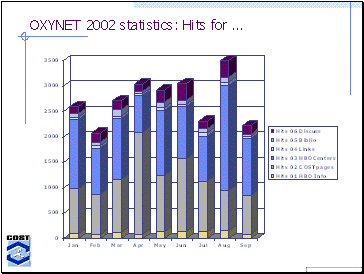
An evaluation of the oxynet web site was performed. The site was well and regularly visited ( between 10 000 and 16 000 visits per month). Users came for a half from Europe and for the other half from the rest of the world. The statistics of website usage showed the most accessed information was regarding general information about HBO, list of registered centres, and the COST B14 Action. ( See annex 1 ).
The working group B was devoted to produce guidelines concerning research studies in the HBOT field. It completed its task for the end of 1999 in producing a document « Research quality Guidelines ». This document stresses the points to be taken into account in research due to the specificity of HBOT.
The working group C has the difficult task of making an inventory of the on-going research protocols in the European HBOT Community and to set-up a priority list for those where a European support was most indicated. Four topics were thought to fulfil both the need of an European co-operative study design and the requirement edited by the working group B.
Specific working groups were established (called Research team in the MoU) and have been working in order to design or adapt research protocols suitable for European co-operative studies. Six protocols are actually implemented and in the patient inclusion phase :
l Hyperbaric Oxygen in the acute treatment of sudden idiopathic sensorineural hearing loss (study co-ordinator : A. Barthelemy, Marseille, France). Study has started in September 2002; 7 centers are participating and 56 patients have been included. To speed on the inclusion process, a randomisation procedure has been implemented through the Internet. The WG agreed to have meetings during the EUBS annual congress in order to continue to monitor the on-going study even after the end of the B14 action.
l Re-irradiation of recurrent squamous cell carcinoma of the head and neck after HBOT sensitisation (study co-ordinator : K. A. Hartmann, Düsseldorf, Germany). Study has started in January 2002.
l Role of hyperbaric oxygen in enhancing radio sensitivity of glioblastoma multiforme : a clinical study (study co-ordinator : F. Fehlauer, Hamburg, Germany). Study has started in January 2002
l Osteo integration in irradiated patients. Adjunctive HBOT to prevent implant failures (study co-ordinator : C. Granstrom, Stockholm, Sweden).Study has started in October 2001.
l Hyperbaric Oxygen in the treatment of foot lesions in diabetic patients (study co-ordinator : D. Mathieu, Lille, France). Study has started in May 2002. 10 centres are participating and 56 patients have been included. Two centers will start to include patients in 2006. Two more centres are still waiting to receive agreement from their Ethic Committee .
l Hyperbaric Oxygen in the treatment of patients with mild to moderate femoral head necrosis (study co-ordinator : L. Ditri, Vincenza, Italy). Protocol has been finalised and patient inclusion has started in 2005.
One other study is in its finalisation phase.
l The role of HBOT in the treatment of late irradiation sequelae in the Pelvic region (study co-ordinator : A. Van der Kleij, Amsterdam, The Netherlands). Protocol will be finalised in 2005 and call for participation launched.
All these protocols are accessible on the Oxynet web site and a discussion forum is opened for each topic.
Even if not research-oriented, a working group, focused on technical and safety aspects of HBOT was also established in order to guarantee that the eventual increase in HBOT use in clinical practice, would not induce an increase in the occurrence of adverse events. The Management Committee decided during its 4th meeting (Copenhagen, February 2000) that the first objective of this working group should be the production of a harmonised European Standard for hyperbaric chambers, and a second, the elaboration of safety guidelines for Hyperbaric Medicine practice.
A risk analysis was elaborated following the EN 1441 document to identify critical areas. In parallel, due to action of participants at their national level, a request, issued by the German Institute for Normalisation (DIN), was introduced and accepted by the CEN which established a specific task force (CEN BT/TF 127) on this topic. Many of the COST participants have been invited to participate in this task force and COST Action B14 has been officially accepted as an external liaison to the BT/TF 127. Documents produced by the working group T were included in the working documentation of this BT/TF. Since the first objective of the working group « T » has been achieved, this working group has been reshaped to undertake its second objective as working group « Safety aspects of HBOT ».
The Working Group Safety (WG-S) was designed in order to summarize expertise of hyperbaric oxygen practitioners in the form of a document “ An European Code of Good Practice in Hyperbaric Oxygen Therapy”. This document has been finalized and approved by the MC during its Turku meeting ( May 2004). Dissemination of this document has included publication on the Oxynet web site for free down-loading and publication in the European Journal of Underwater and Hyperbaric Medicine. The COST program has supported the dissemination in ordering 1100 copies of that journal issue which will be sent to each hyperbaric centre in Europe and to selected opinion leaders in that field.
Most participants from WG Technical Aspects (WG-T) joined the WG-S. This document uses the risk analysis prepared by WG-T and is linked to the project of the European norm concerning construction of multiplace pressure chambers which is being prepared by CEN/BT/TF127. The document is intended to be a reference document for European countries wanting to issue or update their own Guidelines, Regulations, Standards, or Codes of Practice in hyperbaric medicine. In 2003, the chapter concerning safety management and risk analysis was updated to reflect new norm EN ISO 14971 “Medical devices – Application of risk management to medical devices”.
The chairman of the WG-S is officially appointed as an external liaison officer to the CEN/BT/TF127 to ensure that results of both groups will be complementary to each other and regularly participate in TF127 meetings. The close cooperation with CEN/BT/TF127 led to the implementation of results of WGT (Final Report) to TF127 documents.
The “Education and training “ Working Group met at 3 occasions and worked extensively by E-mail exchanges. After an inventory of the various educational courses and diplomas existing in Europe, it based its work on the ECHM/EDTC Standard on Education and elaborated a document defining the level of education and training in order to reach the target level of competencies as well as modular syllabus for educational courses. Allocation of credits for each module makes possible the mutual recognition of diplomas through out Europe as well as the possibility for students to have multi-site education and training . The document was finalised and approved by the MC during its Lille meeting ( December 2004).
An other important task identified by the WG was the needs for an European textbook on hyperbaric oxygen therapy. Up to now, only exist textbooks reflecting the US perspective. Due to differences between the US and European view, the WG decided to proposed to the MC the publication of a multidisciplinary textbook on hyperbaric oxygen therapy, co-authored by the COST B14 members and reflecting the European point of view as well as the advances in the field due to the COST B14 action. The MC approved this suggestion and the MC chairman was designated to edit this textbook.
The “Intensive Care in HBO” met also 3 times. It listed the problems raised by the care of a critically ill patient during HBO in order to prioritise the actions to be done. 2 main actions were identified: the availability of medical devices to be brought in hyperbaric chambers and the frequency of incidents/accidents occurring during the clinical practice. Concerning the first problem, the WG decided to implement a network in order to coordinate the actions and have more impact on manufacturers to require an extension of the CE marking to the hyperbaric atmosphere. Concerning the second problem, 2 actions were done, the first one was to adapt the risk analysis done by the WG “technical aspects “ to the Intensive Care setting. An extensive work done by the Stockholm center was used and proposed to each centre. The second action was to implement a survey on the incidents occurring during HBO according to the level of care required by the patient ( Intensive care or not). This study was reported during the Lille meeting of the WG and it was decided to continue this study. A paper has been presented in the 2005 EUBS annual meeting.
† Dissemination of results
6.1 Publications and Reports
Textbook elaborated by the COST B14 members:
- Handbook on hyperbaric medicine, Springer, Dordrecht (NL), 2006, 812 pages
Reports elaborated in the Working groups:
- Research quality guidelines
- Risk analysis in Hyperbaric Medicine
- European Code of Good Practice
- Competencies and Diplomas in Diving and Hyperbaric Medicine
Publications by COST Action B14 participants with reference to the Action B14
See annex 2 (208 publications)
6.2 Conferences and Workshops
- ECHM Consensus Conference on HBOT in the treatment of diabetic foot lesions,
December 4th-5th, 1998, London, United Kingdom
- ECHM Consensus Conference on HBOT and
radiation-induced lesions in normal
tissues, October 19th-20th, 2001,
Lisbon, Portugal
- ECHM Consensus Conference on Hyperbaric Medicine, December 3rd-4th ,2004, Lille, France
6.3 Web site
www.oxynet.org
6.3.1 Aims and objectives
To facilitate the work of the various research projects within the COST B14 Action
a. To provide and maintain a communication network
- discussion groups
- contact list
b. To provide relevant information
- specialised literature access
To provide information to the HBO community in general
- guidelines for research & research protocols
- address list
6.3.2 Means
Internet :
- easily reached from everywhere
- restricted access possible
- integration of databases possible
- easily updated and maintained
6.3.3 General structure of website
6.3.3.1 Open access
- guidelines document on research
- address listing of HBO centres in Europe
- information about COST
- general information on HBO
- links to free literature search engines
- sponsors page
- links to other HBO organisations web-site
6.3.3.2 Restricted access
- address listing of COST B14 members and collaborators
- discussion groups
- specialised literature access
One password applies to all functions
6.3.4 Address listing
l Table format : name & locality
l Hyperlink to information pages
l addresses and Tel/Fax
l description
l clinical/research interests
l pictures
l e-mail or web-site link
l Register button --> Fill-in form
l Button to restricted address list
6.3.5 Discussion groups
l A discussion group per research project
l Other discussion groups on general interest issues
l Password gives access to all groups
l Management :
l clean-up every 3 months
l reminder e-mail 1 week beforehand
6.3.6 Specialised literature access
l Directed towards literature
1. Not currently available on Medline/Embase
2. Not referenced
3. Of interest and relevance to COST B14 research activities
l Correspondents in each language group
1. COST B14 members
2. selected correspondents
l Abstracts translated if necessary
l Selected for relevance by project leader
l Full text in English in database
6.3.7 Web-site Management
l Financial & sponsorship
l Address listing
l Discussion groups
l Literature database
6.3.8 Evaluation
The site was well and regularly visited ( between 10 000 and 16 000 hits per month). Users came for a half from Europe and for the other half from the rest of the world. The statistics of website usage showed the most accessed information was regarding general information about HBO, list of registered centres, and regarding the COST B14 Action. ( See annex 1 )
6.4 Scientific and Technical Cooperation
- European Committee for Hyperbaric Medicine
- European Underwater and BaroMedical Society
6.5 Transfer of results
Comité Européen de Normalisation (BT/TF 127)
‡ Economic dimension
List estimate of total manpower expressed in person-year dedicated to the activities of the action for each year and the total duration of the action
For the period December 1998-March 2005 (75 months)
- Management Committee : 12 meetings ; 32 persons in average
Estimated time : 740 person-days
- Working groups : 85 meetings
Estimated time : 1112 person-days
Total estimated time : 1852 person-days
(7.4 person-year)
List funds received from the Commission for each year and for the entire duration of the action utilized for Secretariat, Publications, workshop and Seminars, MC meetings, Short-Terms scientific missions, other and Total
1999 : € 11,500 (STSM) + € 7,000 (study) + € 48,000 (meetings) = € 66,500 €
2000 : ……………………………………………………………….€ 89,600 (meetings)
2001 : ……………………………………………………………….€ 74,992 (meetings)
2002 : ……………………………………………………………….€ 70,864 (meetings)
TOTAL :………… .€ 212,356
� Self Evaluation
The MC looks to the action COST B14 as very positive. The structuration of the European hyperbaric community and its integration in a functional clinical and research network has been most advanced during the 6 years of the action.
Main results are :
Research :
· Consensus documents on methods and ethical aspects of clinical research in HBO
· Implementation of a research network in Europe. The work done in this network attracted the participation of South Africa, Australia and Canada.
· 6 clinical randomised controlled studies going on in Europe
Education :
· Structuration of initial and continuous medical education in Europe has been achieved and a common syllabus for each level of education in hyperbaric medicine has been agreed.
· An European textbook has been published, reflecting the view and contribution of European teams.
Quality and safety of clinical care :
Safety of clinical practice is a pre-requisite for the extension of HBO.
· A code of good practice has been elaborated and disseminated to every HBO centre in Europe.
· COST action has been the initiator of the elaboration of an harmonized European norm (pr EN 14 931, prepared by the CEN TF 127)
Communication :
· A web site has been implemented (www.oxynet.org) and is used by the HBO community for its exchange.
These on going activities has been planned to be continued under the supervision of the European Committee for Hyperbaric Medicine (ECHM), an organisation founded in 1990 and aims of which are similar to those of action COST B14.
In summary, the objectives assigned to the action in the MoU have been achieved and, due to the very positive impact of this cooperative action, significant advances have been made in organisation, education, safety and exchanges.
Annex 1
Evaluation of the Oxynet web site
Diapositive 1

Diapositive 2

Diapositive 3
Diapositive 4

Diapositive 5

Annex 2
List of publications
Related to COST action B14
Period 1999 – 2004
A = Abstract
OA = Original article
P = Presentation
R = Report
B = Book
BC = Book Chapter
1999:
Brånemark P-I., Granström G., Bergström K., Tjellström A. Guidelines to the rehabilitation of cancer patients with craniofacial defects using the Osseointegration Concept. Proc Int Congr Oral Cancer, 1999 : 102-105. (OA)
Bürger A., Carl U.M., Glag M. HBO in der Behandlung radiogener Spätfolgen. Caisson 14, 1999 : 72 (A).
Carl UM., Glag M., Hartmann K.A., Schmitt G.: Brusterhaltende Therapie (BET) beim Mammakarzinom Wert der hyperbaren Oxygenierung (HBO) beim symptomatischen Mammaödem. Caisson 14, 1999 : 16 (A).
Carl UM., Glag M., Hartmann K.A., Schmitt G.: HBO beim „symptomatischen Mammaödem“ nach brusterhaltender Therapie (BET). Strahlenther. Onkol. 175, 1999 : Sondernr. 1, NK-P5 (A).
Carl UM.: Therapie radiogener Nebenwirkungen. Bremer Krebskongreß, 1999 : 6. November (P).
Charre S., Neviere R., Mordon S., Marechal X., Mathieu D., Wattel F. L'oxygénothérapie hyperbare modifie le comportement adhésif leucocytaire au cours du choc endotoxinique. Réan. Urg. 1999 ; 8 suppl. : 132s (A).
Delerue P., Mathieu D., Gouello JP., Marian L., Savale A., Linke JC., Alquier PH., Wattel F. Détermination du coût d'une activité médicale élémentaire, l'example de la séance d'oxygénothérapie hyperbare. Mise au point d'une méthode et validation sur deux sites ANGERS et LILLE. Bull. Medsubhyp. 1999 ; 9 : 43-50 (OA).
Germonpré P. « COST Action : Hyperbaric Oxygen Therapy – Un projet Européen de co-opération scientifique. Presented at the XX Jornadas de Medicine Subaquatica, Lisob, Portugal. 22 Oct. 1999 (P).
Glag M., Carl U.M., Hartmann K.A., Bürger A., Schmitt G. Chronische Wundheilungsstörungen nach Bestrahlung-Klinische Erfahrungen mit der hyperbaren Oxygenation. Medizin und Praxis, 1999 ; 15 : 6-11 (OA).
Glag M., Riesenbeck D., Deinert U., Carl UM., Schmitt G.: Bedarfsanalyse zur Notwendigkeit klinischer Studien zur Wertigkeit der hyperbaren Oxygenierung bei der Behandlung radiogener Nebenwirkungen. Caisson 14, 1999 : 20 (A)
Glag M., Sminia P., Hartmann K.A., Carl U.M. Strahlenbiologie in der Strahlentherapie von Tumoren. In : Handbuch der Tauch- und Hyperbarmedizin. Almeling, Böhm, Welslau Eds. Ecomed-Verlag, Landsberg/Lech, 1999 (BC)
Granström G., Bergström K., Carlsson P., Holgers KM., Håkansson B., Odersjö M., Ringdahl A., Tjellström A. Extraoral osseointegrering, erfarenheter från 21 års verksamhet. Svensk ÖNH-tidskrift. 1999 ; 1 : 15. (R)
Granström G., Dib LL., Curi MM. Reabilitaçâo Maxilofacial com o Uso de Implantes Osseointegrados. In: Radioterapi em Oncologia. Salvajoli JV, Souhami L, Faria SL. Eds. MEDSI publishing Co, 1999 : 1165-1180. (BC)
Granström G., Fagerberg-Mohlin B., Lindström J., Mercke C. On the handling of osteoradionecrosis after head and neck cancer therapy. Trans XXV Congr Scand Otolaryngol Soc, 2000 : 292-296. (OA)
Granström G., Tjellström A., Brånemark PI. Osseointegrated implants in irradiated bone. A case-control study using adjuvant hyperbaric oxygen therapy. J Oral Maxillofac Surg., 1999 ; 57 : 493-499. (OA).
Granström G., Tjellström A. Osseointegrated implant surgery in irradiated head and neck cancer patients. Trans XXV Congr Scand Otolaryngol Soc, 2000 ; 241-245. (OA).
Granström G. HBO - a stimulator of osseointegration. Presented at Hyperbaric Medicine, 1999, Columbia, U.S.A. (A).
Granström G. Hyperbar Oxygenbehandling. Erfarenheter från fem års behandling av ÖNH-relaterade sjukdomar. Svensk ÖNH-tidskrift, 1999 ; 1 : 16-17 (R).
Granström G. Mandibular osteoradionecrosis. An investigation of treatment outcome comparing different treatment modalities. Presented at International Head & Neck Oncology Congress, Cape Town, South Africa, 1999 (A).
Granström G. Microradiographic evaluation of retrieved osseointegrated maxillofacial implants. Presented at Nordisk Otolaryngologisk Förenings XXVII Kongres, Odense, Denmark, 1999 ; p 18 (A).
Granström G. Osteoradionecrosis, aspects on background factors and occurrence. Presented at the XI meeting of the Scandinavian Society for Head and Neck Oncology, Tampere, Finland, 1999 (A).
Granström G. Osteoradionecrosis: Its morphology and response to HBO. Presented at Hyperbaric Medicine, 1999, Columbia, U.S.A. (A)
Granström G. Rehabilitation of irradiated head and neck cancer patients by use of the osseointegration concept. Presented at International Head & Neck Oncology Congress, Cape Town, South Africa, 1999. (A)
Hamilton-Farrell MR. 1999. The British Hyperbaric Association carbon monoxide database, 1993-6. Journal of Accident and Emergency Medicine, 1999 ; 16 : 98-103 (OA)
Hamilton-Farrell MR., Pitkin A. Convergence in the management of carbon monoxide poisoning.Undersea and Hyperbaric Medicine Society Annual Meeting, Boston, USA, 1999 (P)
Hartmann K.A., Sminia P., Hulshof M.C.C.M., Carl U.M., González-González D. Radiosensitizing effect of normobaric carbogen during pulsed irradiation of the R1H-tumour. Strahlentherapie und Onkologie 175, Sondernr.1, 1999 : 53 (A).
Hartmann KA., Van der Kleij AJ., Carl UM., Sminia P. Effekte von inspiratorischer Hyperoxie unter normobaren und hyperbaren Bedingungen auf den Oxygenierungsstatus bestrahlter R1H-Tumoren. Caisson 14, 1999 : 25 (A).
Hencke J., Carl UM., Rovers I., Kleine-Brockhoff R. Atemwegsmanagement bei der elektiven HBO tracheotomierter Patienten. Caisson 14, 1999 : 75 (A).
Johnsson ÅA., Jacobsson M., Granström G., Johansson CB., Strid KG. A microradiographic investigation of cancellous bone-healing after irradiation and hyperbaric oxygenation. A rabbit study. Int J Radiation Oncology Biol Phys, 2000 ; 48 : 555-563 (OA)
Johnsson ÅA., Sawai T., Jacobsson M., Granström G., Turesson I. A histomorphometric study of bone reactions to titanium implants in irradiated bone and the effect of hyperbaric oxygen treatment. Int J Oral Maxillofac Impl, 1999 ; 14 : 5 : 699-706. (OA)
Kampen J., Carl U.M. Hyperbaric Oxygen and Radiotherapy. Editrice Salentina – Galatina, Guigno 1999 - M.A.R.E., 1999 : 85-89 (BC)
Kampen J., Lenz R., Tetzlaff K., Carl UM. Hyperbare Oxygenation gefäßgestielter myocutaner Lappenplastiken nach Bestrahlungstherapie bei Kopf-Hals-Tumoren. Exp. Strahlenther. Klin. Strahlenbiol., 1999, 8 : 169-172 (OA).
Lammering G., Carl UM., Pape H., Hartmann K.A. Änderung der Hämoglobinkonzentration bei kombinierter Radio- und Chemotherapie lokal fortgeschrittener HNO-Tumoren. Strahlenther. Onkol., 1999, 175 : 559-562 (OA).
Lenz R., Zimmermann JS., Kampen J., Carl UM. Der Stellenwert der Hyperbaren Oxygenierung (HBO) bei der Behandlung von Tumortherapienebenwirkungen. Caisson 14, 1999 : 19 (A).
Lenz R., Zimmermann JS., Kampen J., Carl U.M. Stellenwert der hyperbaren Oxygenierung (HBO) bei der Behandlung von Tumortherapienebenwirkungen. Caisson, 1999 ; 14 : 34 (OA).
Levin D., Norman D., Zinman C., Rubinstein L., Sabo E., Misselevich I., Reis ND., Boss JH. Treatment of experimental avascular necrosis of the femoral head in rats. Histological evaluation of the femoral heads during the early period of the repair process. Molecular and experimental pathology., 1999 ; 67 : 99-108 (OA).
Mathieu D., Wattel F., Neviere R., Bocquillon N. Accuracy of carbon monoxide (CO) measurement in expired air for the diagnosis of CO poisoning. Undersea Hyperbaric Med. 1999 ; 26 suppl. : 52 (A).
Mathieu D., Wattel F., Neviere R., Bocquillon N. Intracranial infections and hyperbaric oxygen therapy : a five year experience. Undersea Hyperbaric Med. 1999, 26 suppl. : 67 (A).
Mueller, Peter H.J.: Bioelectrical Impedance Analysis as a Useful Tool to Monitor Body Fluids of Critically Ill Patients Undergoing Hyperbaric Oxygen Therapy. Undersea Hyperb Med 1999 (26), Suppl.: 68 (A192). (A)
Mueller, Peter H.J.: European Safety Standards. In: W.T. Workman (ed.): Hyperbaric Facility Safety: A practical guide. Best Publishing Co., Flagstaff, Arizona, 1999: 77-102. (BC)
Mueller Peter HJ: HBO-Therapie: Einstiegsmöglichkeiten und Grenzen. Vortrag im Rahmen der Fortbildungsveranstaltung der Medizinischen Klinik des Diaknossenkrankenhauses Mannheim, 16.03.1999. (P)
Mueller, Peter H.J., B. Neubauer, T.S. Mutzbauer, K. Tetzlaff: Hyperbaric Oxygen Therapy as Cause of a Pulmonary Barotrauma. Program & Abstracts of the 13th International Congress on Hyperbaric Medicine (ICHM) , Kobe, Japan, November 7-12,1999: 66. (A)
Mueller, Peter HJ: Hyperbare Sauerstofftherapie, eine neue Behandlungsoption am Diakonissenkrankenhaus Mannheim. Heimkehr, 1999. (OA)
Mueller, Peter H.J.: Staffing and Training Issues in Europe. In: W.T. Workman (ed.): Hyperbaric Facility Safety: A practical guide. Best Publishing Co., Flagstaff, Arizona, 1999: 269-293. (BC)
Palmedo H., Bender H., Dierke-Dzierzon, Carl U.M., Risse J., Krebs D., Biersack HJ. Pain palliation with rhenium-186 HEDP in breast cancer patients with disseminated bone metastases. Clin. Nucl. Med., 1999, 9 : 643-648 (OA).
Palmedo H., Carl U.M., Grünwald F., Schneeweiss FHA., Schmitt G. Schmerztherapie mit Rhenium-186 HEDP und HBO bei dissemenierter Knochenmetastasierung: Experimentelle und klinische Erfahrungen. Caisson 14, 1999 : 23 (A).
Petzold T., Feindt P.R., Carl U.M., Gams E. Hyperbaric Oxygen Therapy in Deep Sternal Wound Infection After Heart Transplantation. Chest, 1999 ; 115 : 1455-1458 (OA)
Petzold Th., Feindt PR., Boeken U., Carl UM., Gams E. Hyperbare Sauerstofftherapie (HBO) in der Behandlung einer tiefen sternalen Wundheilungsstörung nach Herztransplantation. Caisson 14, 1999 : 81 (A).
Peusch-Dreyer D., Carl UM., Dreyer KH. Hyperbare Sauerstofftherapie (HBO) als Behandlungsmethode bei chronischer Strahlenproktitis. Caisson 14, 1999 : 15 (A).
Peusch-Dreyer D., Dreyer KH., Carl UM. Hyperbare Sauerstofftherapie bei hämorrhagischer Strahlencystitis. Caisson 14, 1999 : 14 (A).
Peusch-Dreyer D., Dreyer KH., Müller CD., Carl UM. Einsatz der Hyperbaren Sauerstofftherapie (HBO) bei strahlenbedingten Miktionsbeschwerden. Caisson 14, 1999 : 13 (A).
Pott F, Westergaard P, Mortensen J, Jansen EC. Hyperbaric oxygen treatment and pulmonary function. Undersea Hyperb Med 1999 ; 26 : 225-8 (OA)
Schmutz J. Is there a place for HBO in the treatment of the diabetic foot? Invited lecture at the department of angiology. University hospital Zürich. (P)
Schneeweiss FHA., Dormehl IC., Palmedo H., Carl UM. Palliative Behandlung von Patienten mit ossär metastasiertem Prostatakarzinom mittels 186-Re-HEDP und hyperbarem Sauerstoff. Caisson 14, 1999 : 24 (A).
Schoppa M., Glag M., Carl UM. Prospektive Beurteilung der Inzidenz posttherapeutischer Mammaödeme nach brusterhaltender Therapie (BET). Caisson 14, 1999 : 71 (A).
Sminia P, Hartmann KA, Carl UM, Jansen W, van der Kleij AJ. Hyperbaric oxygen as prophylaxis for late radiation induced neurological complications? A preliminary experimental report. Caisson 14, 1999 : 32 (A).
Sminia P., Hartmann KA., Hulshof MCCM., Carl UM. Radiosensitizing effect of normobaric carbogen in a rat tumour model. Caisson 14, 1999 : 69 (A).
Støre G, Granström G. Osteoradionecrosis of the mandible. A microradiographic study of cortical bone. Scand. J Plast. Reconstr. Hand Surg. 1999 ; 33 : 307-314. (OA)
Tsamaloukas AG., Carl UM. Chemotherapie (CTX) – indizierte pulmonale Toxizität: Ein mögliches Risiko der HBO bei onkologischen Patienten. Caisson 14, 1999 : 27 (A).
Turner M, Hamilton-Farrell MR, Clark RJ. Carbon monoxide poisoning: an update. Journal of Accident and Emergency Medicine 1999 ; 16 : 92-98, (OA).
2000:
Bonneil P., Mathieu D., Neut C., Bocquillon N., Charre S., Dubreuil L., Wattel F. Bactériologie des infections anaérobies des tissus mous : Influence de la localisation. Réan. Urg. 2000 ; 9 suppl 2 : 126s (A).
Carl UM. Die Behandlung strahlenbedingter Nebenwirkungen mit hyperbarem Sauerstoff. Anästhesiologisches Kolloquium 2000/Martin-Luther-Universität Halle. 06. Jun (P).
Carl UM. HBO-Forschung im Europaeischen Forschungsrahmen COST. In : Proceedings of the 28th Annual Scientific Meeting of the European Underwater and Baromedical Society. Germonpre P., Balestra C., Eds. 2000 ; 15 : 20 (R).
Carl UM. Lebensqualität nach Brustkrebs – Ein erklärtes radioonkologisches Ziel. Akademie für ärztliche Fortbildung/ÄK Niedersachsen 08. Juni 2000 (P).
Carl UM. Pathophysiologie der Strahlenreaktion und hyperbarer Sauerstoff als therapeutische Option. Akademie für ärztliche Fortbildung/ÄK Niedersachsen 06. September 2000 (P).
Carl UM. Symptomatisches Mamma-Ödem bei brusterhaltender Krebstherapie. Symposium „Lebensqualität trotz Krebs“. 08. November 2000 (P).
Carl UM., Glag M., Hatmann KA., Schmitt G. „Symptomatisches Mammaödem“ nach brusterhaltender Therapie wegen Mammakarzinom und die Bedeutung der Therapieoption mit HBO. Caisson 15, 2000 : 21 (A).
Granström G., Fagerberg-Mohlin B., Lindström J., Mercke C. On the handling of osteoradionecrosis after head and neck cancer therapy. Trans XXV Congr Scand Otolaryngol Soc 2000 : 292-296. (OA)
Granström G., Tjellström A. Osseointegrated implant surgery in irradiated head and neck cancer patients. Trans XXV Congr Scand Otolaryngol Soc 2000 : 241-245. (OA)
Granström G. Long-term results with the Brånemark system in irradiated and non-irradiated patients. Laryngo. Rhino. Otol. 2000 ; 79S : 92. (A)
Granström G. Long-term results with the Brånemark system® in irradiated and non-irradiated patients. In : 4th European Congress of Oto-Rhino-Laryngology, Head and Neck Surgery. Jahnke K, Fischer M, Eds. Monduzzi, Italy, 2000 : 635-639. (OA)
Granström G. Measurement of Bone Metal Contact (BMC) in retrieved maxillofacial osseointegrated implants. Acta Otolaryngol (Stockh) 2000 ; 543S : 114-117. (OA)
Granström G. Microradiographic study of retrieved craniofacial implants. ORL, 2000 ; 62 : 26-32. (OA)
Granström G. Osseointegrated implants in jaw surgery. Lääkäripäivät 2000 ; 150. (A)
Hamilton-Farrell MR. Carbon monoxide poisoning - a British perspective. In : Carbon Monoxide Poisoning. Penney D., Ed.. CRC Press, Boca Raton (USA) 2000 (BC)
Hartmann KA., Carl UM., Sminia P., Lammering G., Becker KA., Schmitt G. The influence of inspiratory hyperoxia on ischemia-reperfusion-induced tumour growth delay. Oncol Rep. 2000 ; 7 : 131-333 (OA).
Hartmann KA., Feldmeier JJ., Schmitt G., Carl UM. Hyperbaric oxygen therapy (HOT) is an effective treatment option for patients with persisting symptomatology after breast conserving surgery and radiation. Strahlenther. Onkol. 2000 ; 176 : 80 (A).
Houman R. The timelines of a European standard regarding safety in hyperbaric chamber for oxygen treatment. Celostatni konference asociace pracovniku v hyperbarické medicine. Smery a cile hyperbarické mediciny po roce 2000. Praha (CZ) p 8 – 15 (P).
Houman R. Normalisation européenne en matière de sécurité et d’équipements médicaux: application aux installations hyperbares thérapeutiques. Annales Medicinae Militaris. Ann. Med Milit Belg 2000 vol 14 (4) p215 (A)
Jansen EC. Hyperbaric medicine. An update. Guest lecturer at 1st International Meeting The Egyptian Working Group on Critical Care Medicine. Cairo 13.april 2000 (P).
Johnsson ÅA., Jacobsson M., Granström G., Johansson CB., Strid KG. A microradiographic investigation of cancellous bone-healing after irradiation and hyperbaric oxygenation. A rabbit study. Int J Radiation Oncology Biol Phys 2000 ; 48 : 555-563 (OA)
Johnsson ÅA., Sawaii T., Jacobsson M., Granström G., Turesson I. A histomorphometric and biomechanical study of the effect of delayed titanium implant placement in irradiated bone. Clin Impl Dent Rel Res 2000 : 2 : 1 : 42-49. (OA)
Lenz R., Zimmermann JS., Kampen J., Carl UM. Stellenwert der hyperbaren Oxygenierung (HBO) bei der Behandlung von Tumortherapienebenwirkungen. Tauch und Überdruckmedizin, 2000 ; 6: 220-226 (OA).
Mathieu D. Transcutaneous oxymetry in hyperbaric medicine. In : Proceedings of the XXVI Annual Scientific Meeting of the European Underwater and Baromedical Society. R. Cali-Corleo éd., Malte. 2000 : 64-69 (OA).
Mathieu-Nolf M., Mathieu D. Treatment of Carbon Monoxide poisoning in France. In : Carbon Monoxide Toxicity. Penney D., Ed. CRC Press, Boca Raton, USA. 2000 : 291-310 (BC).
Mathieu-Nolf M., Mathieu D., Durak-Carpeza C., Linke JC., Coquelle-Couplet V. A one-year longitudinal study of 563 carbon monoxide poisonings in north of France. J. Tox. Clin. Tox. 2000 ; 28 : 217 (A).
Mueller PHJ. COST Action B14 « Hyperbaric Oxygenation ». Presented at the VDD Mitgliederversammlung, Kassel, Germany, 02.02.2000 (P).
Mueller Peter HJ: Der Einsatz der HBO-Therapie in der Viszeralchirurgie: Möglichkeiten und Grenzen. Vortrag im Rahmen des Fortbildungskolloquiums der Klinik für Allgemein- und Thoraxchirurgie am Universitätsklinikum Mannheim, 16.02.2000. (P)
Mueller, Peter HJ: HBO-Zentrum Rhein-Neckar, ein Jahr erfolgreiche HBO-Therapie im Diakoniekrankenhaus Mannheim. Heimkehr, 2000. (OA)
Mueller, Peter HJ: Stellenwert der HBO-Therapie bei der Behandlung von Problemwunden. Vortrag beim Tag der offenen Tür, Diakoniekrankenhaus Mannheim, 11.03.2000. (P)
Mueller, Peter H.J. & H. Pauli: Testing of a Modified Build-In-Breathing-System for Hyperbaric Oxygen Therapy with an Online Measurement of Oxygen Consumption. Undersea Hyperb Med 2000 (27), Suppl.: 33 (A77). (A)
Peusch-Dreyer D., Carl UM., Dreyer KH. Der Einsatz der HBO-Therapie bei der chronischen Strahlencystitis. Tauch und Überdruckmedizin, 2000 ; 6 : 207-216 (OA).
Sparrow L., Mathieu D., Wattel F., Lancry A., Neviere R. Effects of breathing air at 4 atm abs : evidence for a change in strategy. Undersea Hyper Med. 2000 ; 27 : 125-30 (OA).
Van den Berg AP., van Geel CAJF., van Hooije CMC., van der Kleij AJ., Visser AG. Tumor hypoxia - a confounding or exploitable factor in interstitial brachytherapy ? Effects of tissue trauma in an experimental rat tumor model. Int J Radiat Oncol Biol Phys, 2000 ; 48 : 233-240 (OA).
2001:
Cali-Corleo, R. & P.H.J. Mueller: The European College of Baromedicine. South Pacific Underwater Medicine Society (SPUMS) Journal, Vol. 31, March 2001: 29-30. (R)
Carl UM., Hartman KA., Van der Kleij AJ., Sminia P. Effects of hyperbaric oxygen (HBO) and normobaric carbogen on the radiation response of the rhabdomyosarcoma R1H. Eur J Underwater Hyperb Med 2001 ; 2 : 86-87 (OA).
Carl UM., Feldmeier JJ., Buerger A., Hartmann KA. Hyperbaric oxygen in the treatment of radiation therapy sequelae. Europ. J. Undersea Hyperbaric Med., 2001 ; 2 : 8-10 (OA).
Carl UM., Feldmeier JJ., Schmitt G., Hartmann KA. Late radiation sequelae in women after breast conserving therapy. Effects of hyperbaric oxygen therapy (HBO). Diving and Hyperbaric Medicine. In : Proceedings of the XXVII Ann. Meeting EUBS, 2001 ; 154-155 (A).
Carl UM., Hartmann KA., Feldmeier JJ., Schmitt G. Hyperbaric oxygen therapy (HOT) for late sequelae in women receiving radiation after breast conserving surgery. Int. J. Rad. Oncol. Biol. Phys., 2001 ; 49: 1029-1031(OA).
Carl UM. Hyperbaric Oxygen (HBO) for Radiation Sequelae. Oncology Seminar – University Maastricht. 08. Februar 2001(P).
Carl UM. Pathophysiologie der Strahlenreaktion und hyperbarer Sauerstoff als therapeutische Option. Symposium „Sauerstoffüberdrucktherapie“. Universität Frankfurt am Main, 06.-07. April 2001 (P).
Carl UM. Pathophysiology der Strahlenwirkung und HBO. Sauerstoffüberdrucktherapie als therapeutische Option. 39. Jahrestagung Deutsche Gesellschaft für Plastische und Wiederherstellungschirurgie. Berlin, 11.-13. Oktober 2001 (P).
Ditri L., Grigoletto F. Aseptic Bone Necrosis and HBO2: European Protocol of COST Action B14. Presented at “Iperbarica 2001”, Bologna.2001 (P)
Granström G. Pathophysiological basis for HBO in the treatment of healing disorders in radio-injured normal tissues. In: Proceedings of the 5th ECHM Consensus Conference, Lisbon, 2001 ; 85-93. (BC)
Granström G. Radiotherapy, osseointegration and hyperbaric oxygen therapy. In: Periodontology 2000, D. Van Steenberghe (ed). Munksgaard, Copenhagen. By invitation. 2001. (BC)
Hampson NB., Mathieu D., Piantadosi CA., Thom SR., Weaver LK. Carbon monoxide poisoning : interpretation of randomized clinical trials and unresolve treatment issues. Undersea Hyper Med. 2001 ; 28 : 157-64 (OA).
Hartmann KA., Van der Kleij AJ., Carl UM., Hulshof MCCM., Willer R., Sminia P. Effects of hyperbaric oxygen and normobaric carbogen on the radiation response of the rat rhabdomyosarcoma R1H. Int J Radiat Oncol Biol Phys, 2001 ; 51 : 1037-44 (OA).
Hartmann KA., Van der Kleij AJ., Hulshof MCCM., Carl UM., Sminia P. Hyperbaric oxygen does not enhance tumour growth and metastatic potential of the rhabdomyosarcoma R1H. Eur J Cancer, 2001 ; 37 : suppl6 : S199/728 (A).
Hartmann KA., Van der Kleij AJ., Hulshof MCCM., Carl UM., Sminia P. Effects of hyperbaric oxygen therapy and normobaric carbogen on the radiation response of the rhabdomyo-sarcoma R1H. In: Proceedings of the European Underwater & Baromedical Society (EUBS) 27th Annual Scientific Meeting on Diving and Hyperbaric Medicine - 30th Anniversary of EUBS, U. Van Laak, Ed., Hamburg, Germany. 2001 : 156-58 (A).
Hink J, Jansen EC. Are super oxide and/or hydrogen peroxide responsible for some of the beneficial effect of hyperbaric oxygen therapy? Medical Hypothesis. 2001 1 ; 57 : 764-9 (OA).
Houman R. Therapeutical Hyperbaric Facilities in Europe are medical devices, consequences. Proceedings of the European Underwater & Baromedical Society (EUBS) 27th Annual Scientific Meeting on Diving and Hyperbaric Medicine. 30th Anniversary of EUBS, U. Van Laak, Ed., Hamburg, Germany. 2001: 125 - 129 (OA)
Jansen EC. Hyperbaric medicine. Lectures at a medico technical conference, Expomed 2001. Istanbul, Turkey, April 30th and May 1st 2001 (P).
Jansen EC. Hyperbaric treatments of CO-intoxicated in Denmark. 22nd Nordic meeting for intoxication information centers. Gilbjerghoved, Denmark September 7nd, 2001 (P).
Jansen EC. Trykkammerbehandling, teknik og akutte indikationer.( Hyperbaric chamber treatments, technique and emergency indications) For anaesthesiologists in training. Rigshospitalet, Copenhagen October 25th, 2001 (P).
Kot J. Meeting of the Management Committee of the COST B14 “Hyperbaric Oxygen Therapy” 19th – 21st April, 2001, Gdynia, Poland. Internat. Marit. Health, 2001: 52(1-4): 176-178. (R)
Mathieu D. Place de l’Oxygénothérapie Hyperbare dans le traitement des fasciites nécrosantes. Ann Dermatol Venereol. 2001 ; 128 : 411-8 (OA).
Mathieu D., Wattel F., Bocquillon N., Charre S., Linke JC. Anaerobic Pleuropulmonary Infections : a potential indication for adjunctive hyperbaric oxygen therapy in selected cases for adjunctive hyperbaric oxygen therapy in selected cases. Undersea Hyper Med. 2001, 28 suppl : 59 (A).
Mathieu-Nolf M., Mathieu D. Carbon Monoxide Poisoning : Specificity of child Intoxication. Undersea Hyper Med. 2001, 28 suppl : 17 (A).
Mathieu-Nolf M., Mathieu D., Linke JC., Nisse P. Clinique et diagnostic de l’intoxication par le monoxyde de carbone. Allerg Immunol. 2001 ; 33 : 332-3 (OA).
Mueller PHJ. COST Action B14 « Hyperbare Oxygenation ». Presented at the Treffen der Arbeitsgruppe « Hyperbare Sauerstofftherapie » in der DGAI, Kassel, Germany, 24.03.2001 (P).
Mueller Peter HJ: Der Einsatz der HBO-Therapie der Unfallchirurgie: Möglichkeiten und Grenzen. Vortrag im Rahmen des Fortbildungskolloquiums der Klinik für Unfallchirurgie am Universitätsklinikum Mannheim, 08.05.2001. (P)
Mueller PHJ. Die Website « Oxynet » der COST Action B14. Rundschreiben des VDD 1/2001 (R).
Mueller, Peter H.J., F. Guessow-Voye & K. Zuechner: Evaluation of a new humidification device for breathing gases under hyperbaric conditions. Undersea Hyperb Med 2001 (28), Suppl.: 79 (A147). (A)
Mutzbauer, Till S.; B. Neubauer; P.H.J. Mueller; O. Sigg & K. Tetzlaff: Can Eustachian Tube Ventilatory Function Impairment After Oxygen Diving Be Influenced by Application of Free Radical Scavenger Vitamins C and E? LARYNGOSCOPE 2001;111:861-866 (OA)
Pirone, C. & P.H.J. Mueller: UHMS Workshop 2001 “Patient Safety”. Europ J Underwater Hyperbaric Med 2001 (2), 4: 111-112. (R)
Schmutz J. Effect of HBO in radiation injury of the brain. Invited lecture at the department of neurosurgery. University hospital Basel. (P)
Schmutz J. Review of the effect of Hyperbaric oxygen therapy in radiation injury. Proceedings of the 5th ECHM Consensus Conference, Lisbon, 2001;85-93. (BC)
Schwarz O., Reis ND. Avascular necrosis of the head of the femur stage 1 : treatment by hyperbaric oxygen compared to an untreated control group. EFORT congress, Rhodes, 2001. (P)
Sminia P., Hartman KA., Schneider CJ., Carl UM., Van der Kleij AJ., Slotman BJ., Hulshof MCCM. Radiosensitizing effect of carbogen breathing during pulsed irradiation of the rat R1H tumor. Acta Oncol., 2001 ; 40 : 870-874 (OA).
Sminia P. 'Radiation Enhancement” and “Tumor Oxygenation”, Hyperbaric Medicine course, Academic Medical Center, Amsterdam, The Netherlands, September 7, 2001 (P).
2002:
Barthelemy E., Germonpré P., Heiden C., Jansen E., Rocco M.Hyperbaric oxygen in the treatment of sudden deafness (SD) after failure of previous medical treatment. Working group 1, COST action B14. In : Proceedings of the 28th Annual Scientific Meeting of the European Underwater and Baromedical Society. Germonpre P., Balestra C., Eds. 2002 : 173-178 (OA).
Bonde C., Jansen E., Heslet L., Elberg J. Treatment of compromised circulation in pedicle flap. Danish Society for Microsurgery, Middelfart, 22nd March 2002 (P)
Ditri L., Grigoletto F., Melamed Y., Reis D., Cucci L., Germonpre P., Mesimeris T., Montanari M., Ratzenhofer-Komenda B., Rocco M., Travnik L., Vande Berg B. Femoral head necrosis and hyperbaric oxygen – a MRI study. Study protocol adopted from the COST B14 Working Group « 2 ». In : Proceedings of the 28th Annual Scientific Meeting of the European Underwater and Baromedical Society. Germonpre P., Balestra C., Eds. 2002 : 81-85 (OA)
Fledelius HS., Jansen EC., Thorn J. Refractive change during hyperbaric oxygen therapy. A clinical trial including ultrasound oculometry. Acta Opthalmol. Scand.2002:80:188-190. (OA)
Hamilton-Farrell MR. Cooperation on Science and Technology action B14 (Hyperbaric Oxygen). European Journal Undersea and Hyperbaric Medicine, 2002 ; 3 : 8 (R).
Houman R., Desola J., Gough-Allen R., Jansen E., Kot J., Lo Savio F., Mandenoff A., Méliet JL., Mueller P., Schmutz J., Simao A. COST Action B14 : Working group technical aspects : results. Working Group ‘Technical Aspects’ – COST B14 Action. In : Proceedings of the 28th Annual Scientific Meeting of the European Underwater and Baromedical Society. Germonpre P., Balestra C., Eds. 2002 ; 126-128. (OA)
Hulshof MCCM., Stark NM., Van der Kleij AJ., Sminia P., Smeding HMM., González González D. Hyperbaric Oxygen Therapy for Cognitive Disorders after Irradiation of the Brain. Strahlenther Onkol 178, 2002 ; 4 : 192-198 (OA).
Jansen E. Behandlinger med hyperbar medicin – en oversigt. ( Hyperbaric oxygen treatments – an overview.Da.). Danish Associations for Aerospace and Diving Medicine, Copenhagen, March 2nd, 2002 (P)
Jansen E., Jessen B. Forskning i hyperbar medicin og dykkermedicin.( Science in hyperbaric medicine and diving medicine) Danish Associations for Aerospace and Diving Medicine, Copenhagen, March 2nd, 2002 (P)
Jansen E. Hyperbaric oxygen and its effect on microcirculation. Danish Society for Microsurgery, Middelfart, 21nd March 2002 (P)
Jansen E. Vedligehold, near miss culture, akreditering og tekniske uddannelse i hyperbar medicin. Danish Associations for Aerospace and Diving Medicine, Copenhagen, March 2nd, 2002 (P)
Jensen SS., Heslet L., Rasmussen og N., Jansen EC. Cervical necrotizing fasciitis with a dental focus. (Da.: Cervikal nekrotiserende fasciitis med odontogent fokus). Tandlægebladet, Danish Dental Bulletin 2002, 106;4, 208-211 (OA)
Lindekær A., Jansen E. Kulilteforgiftning. (Carbonmonooxide intoxication, Da.) Danish Associations for Aerospace and Diving Medicine, Copenhagen, March 2nd, 2002 (P)
Longobardi P. “Ferite problematiche ed OTI: lo stato dell’arte – Piede diabetico: progetto COST”. Meeting A.I.M.O.S. (Sardinia Interdisciplinary Hospital Medical Society), Cagliari, 31 May-1 June 2002 (P).
Longobardi P. “La visita di idoneità del subacqueo professionista: l’approccio europeo (ECHM-EDTC)”. XV National Meeting SIMSI, Palermo 14-16 September 2002 (P).
Longobardi P. "OTI nel protocollo di trattamento del piede diabetico: Progetto europeo Cost Action B14" - Proceedings Meeting : Approccio Multidisciplinare al Piede Diabetico : un percorso obbligato per ridurre le amputazioni. Milano. 2002. (P)
Longobardi P. “Piede diabetico: protocollo di ricerca dell’Unione Europea COST Action B14: Hyperbaric Oxygen Therapy” XV National Meeting SIMSI, Palermo 14-16 September 2002 (CME n° 4471-11441: 13 credits) (P).
Longobardi P. “Profili professionali nella medicina subacquea ed iperbarica: indirizzo europeo (ECHM-EDTC)”. XV National Meeting SIMSI, Palermo 14-16 September 2002 (P).
Mathieu D. Hyperbaric oxygen therapy in the treatment of diabetic foot lesions – A randomized controlled prospective study. Working Group ‘HBO and diabetic foot lesion’ of COST B14 action. In : Proceedings of the 28th Annual Scientific Meeting of the European Underwater and Baromedical Society. Germonpre P., Balestra C., Eds. 2002 ; 68. (A)
Mathieu D. Hyperbaric Oygen Therapy in the management of non-healing wounds. In : Hyperbaric Surgery. Bakker D., Cramer F., Eds, Best Publishing Company, Flagstoff (USA). 2002 (BC).
Meliet JL., Desola J., Gata AS., Gough-Allen R., Houman R., Kot J., Mortensen C. Mueller P., Sipinen S. Editing rules of good practice for hyperbaric medicine. COST Action B14. In : Proceedings of the 28th Annual Scientific Meeting of the European Underwater and Baromedical Society. Germonpre P., Balestra C., Eds. 2002 ; 116-120 (OA).
Mueller PHJ: Review of Screening Procedures for Elective Hyperbaric Admission. In: Mueller, Peter HJ; C. Pirone & P. Barach (eds.): Patient Safety: Prevention and Treatment of Complications in Hyperbaric Medicine. The 52nd Workshop of the Undersea and Hyperbaric Medical Society. UHMS Inc., Kensington, Maryland, 2002: 126-132. (BC)
Mueller PHJ. COST Action B14 « Hyperbare Oxygenation », aktueller Stand. In : Proceedings of the 28th Annual Scientific Meeting of the European Underwater and Baromedical Society. Germonpre P., Balestra C., Eds. 2002 ; 17 (R).
Mueller, Peter HJ: Review of Screening Procedures for Elective Hyperbaric Admission. In: Mueller, Peter HJ; C. Pirone & P. Barach (eds.): Patient Safety: Prevention and Treatment of Complications in Hyperbaric Medicine. The 52nd Workshop of the Undersea and Hyperbaric Medical Society. UHMS Inc., Kensington, Maryland, 2002: 126-132. (B)
Perttilä J. Hyperbaric oxygen treatment of the critically ill patient. Journal of the Finnish. Medical Association. 2002 ; 57 : 2649-2655 (In Finnish). (OA)
Perttilä J. Hyperbaric oxygen therapy. Spirium. 2002 ; 37 : 25-28 (In Finnish). (OA)
Peskin B., Shupak A., Levin D., Norman D., Jacob Z., Boss JH., Misselevich I., Reis ND., Zinman C. Non weight bearing and hyperbaric oxygen therapy in vascular deprivation induced avascular necrosis of the femoral head J. Underwater and hyperbaric medicine. J. Undersea Hyperbaric Med (in press), 2002. (OA)
Reis ND., Schwarrz O., Militianu D., Ramon Y., Levin D., Norman D., Melamed Y., Shupak D., Golsher D., Zinman C. Diffuse Bone Oedema combined with sub-chondral lesions the head of the femur staged AVN I: An MRI study of the treatment by hyperbaric oxygen. Submitted to the J.Bone Joint Surg, 2002. (OA)
Rottensten H., Mortensen CR. Nekrotiserende fasceiitis. Danish Associations for Aerospace and Diving Medicine, Copenhagen, March 2nd, 2002 (P)
Schmutz J. Effect of HBO in radiation injury of the ENT region. Invited lecturer at the ENT Department. University hospital Zürich. (P)
Schwarz O., Reis ND. Avascular necrosis of the head of the femur :results of treatment of grade 1 lesions by hypoerbaric oxygen. SICOT, Leningrad. 2002. (P)
Sminia P., Schmutz J., Hamilton-Farrell M., Sicko Z., Melamed Y., Jansen E., Luciano D., Carl U., Granström G., Van der Kleij AJ. Hyperbaric oxygen and radiotherapy. An intermediate report from the COST B14 working group oncology. In : Proceedings of the 28th Annual Scientific Meeting of the European Underwater and Baromedical Society. Germonpre P., Balestra C., Eds. 2002 ; 75-77. (OA)
Wattel F., Mathieu D. (eds), Traite de Medecine Hyperbare. Ellipse, Paris, 2002, 712 pages. (B)
2003
Fanger B., Jansen EC. Necrotizing fasceiitis and hyperbaric oxygen treatment, a multiprofessional apporach. Danish Society of Anaesthesia and Intensive Care, Copenhagn, November 7th, 2003 (P).
Feldmeier J., Carl U., Hartmann K., Sminia P. Hyperbaric oxygen : Does it promote growth or recurrence of malignancy ? Undersea Hyperb Med. 2003 ; 30 : 1-18 (OA).
Hamilton-Farrell MR., Bhattachariya A. Barotrauma. Injury. Accepted for publication 2003 (R)
Hink J., Jansen E. Titanium in a hyperbaric oxygen environment poses a fire risk. Aviation and Space, and Environmental Medicine. 2003 ; 74 : 1301-1302. (P)
Houman R. Hyperbaric Medicine Technology and safety : integration of European Directives. Proceedings of the 29th Annual Scientific Meeting of the European Underwater and Baromedical Society. Jansen E, Mortensen C, Hyldegaard O Eds, Copenhagen. Danmark 2003; 109 (A).
Houman R. Normalisation of therapeutic hyperbaric systems: interpretation of the essential requirements of European Directive CE 93/42 in terms of standards. Proceedings of the 29th Annual Scientific Meeting of the European Underwater and Baromedical Society. Jansen E, Mortensen C, Hyldegaard O Eds, Copenhagen. Danmark 2003; 110 (A).
Jansen EC. Safety for attendant during hyperbaric treatments. Svenska Hyperbarmedicinslk Selskabs årsmøde (Swedish Hyperbaric Medical Society, annual meeting), 26-28 May 2003, Korsö, Stockholm. (P)
Jansen EC. Hyperbaric attendant safety in Denmark, a prepared contribution to the discussion at the consensus meeting of the European Committee of Hyperbaric Medicine. Geneve October 25th, 2003. (P)
Jansen T, Barnung S, Mortensen CR, Jansen EC. Isobutyl-nitrite induced methemoglobinemia; treatment with Blod transfusion during hyperbaric oxygenation. Acta Anaesthesiologica Scandinavica, November 2003, 47 : 1300-1301. (OA)
Juhl HJ, Buchwald C, Bollinger B, Jansen EC. Extensive pneumosinus dilatans in the maxilla (Da.:Ekstensiv pneumosinus dilatans i maxillen.) Ugeskrift for læger, 2003 26 ; 165 : 2203-4. (OA)
Kentala E, Perttilä J. Carbon monoxide poisoning and hyperbaric oxygen therapy. Journal of the Finnish Intensive Care. 2003 ; 21 : 54-55 (In Finnish). (OA)
Kentala E, Perttilä J. Hyperbaric oxygen for acute carbon monoxide poisoning. Journal of the Finnish Medical Association. 2003 ; 58 : 2635-2638 (In Finnish). (OA)
Longobardi P. “L’esperienza italiana ed europea: Stato dell’arte – COST Action B14”. Meeting: “Ossigenoterapia iperbarica tra presente e futuro”. Mestre (VE), 27-28 February 2003 (P).
Longobardi P. “L’OTI nel piede diabetico: progetto EU COST B-14”. National Meeting SIAARTI-SIMSI, Salerno 19-20 September 2003 (P).
Longobardi P. “Necrosi asettica della testa del femore (F.H.N.) – Progetto EU COST B14” Degree Thesis dr. Roberto Novelli at University of Chieti – Postgraduated School of Diving and Hyperbaric Medicine. Academic Year 2002-2003 (P).
Mueller Peter HJ: Der Einsatz der HBO-Therapie in der Sporttraumatologie: Einstiegsmöglichkeiten und Grenzen. Vortrag beim 5. Internationaler ARCUS-Sportmedizin-Kongress, 14.06.2003, Gardasee/Italien. (P)
Mueller, Peter HJ: Hyperbare Sauerstofftherapie in der Sporttraumatologie: Einstiegsmöglichkeiten und Grenzen. Abstracts, 5. Internationaler ARCUS-Sportmedizin-Kongress, 07.-14.06.2003, Gardasee/Italien: 106-109. (A)
Mueller, Peter HJ & TS Mutzbauer: Hyperbaric Oxygen Therapy in a Patient with Pre-Excitation Syndrome. A Case Report. Undersea Hyperbaric Med 2003 (30): A121. (A)
Niinikoski, Juha: Hyperbaric oxygen therapy of diabetic foot ulcers, transcutaneous oxymetry in clinical decision making. Wound Repair & Regeneration. 2003 ; 11 : 458-461 (OA).
Niinikoski, Juha: Clinical hyperbaric oxygen therapy, wound perfusion and transcutaneous oxymetry. World Journal of Surgery, accepted for publication, 2003.
Shanker M., Hamilton-Farrell MR. Ischaemic necrosis of the maxilla - a case report. British Journal of Maxillo-facial Surgery.Accepted for publication 2003 (OA).
Sminia P., Acker H., Eikesdal HP., Kaaijk P., Enger PO., Slotman BJ., Bjerkvig R. Oxygenation and response to irradiation of organotypic multicellular spheroids of human glioma. Anticancer Res. 2003 ; 23 : 1461-1466 (OA).
Sminia P. Van Der Kleij AJ., Carl UM., Feldmeier JJ., Hartmann KA. Prophylactic hyperbaric oxygen treatment and rat spinal cord re-irradiation. Cancer Letters. 2003 ; 191 : 59-65 (OA).
Vutovic M, Kock-Jensen P, Jansen EC. Variations of the retina blood vessels diameter during and after treatment with hyperbaric oxygen. British Journal of Ophtalmogy, accepted, April 2003. (OA)
Warburg F., Fanger B., Jansen EC. Necrotizing fasceiitis and hyperbaric treatment, a retrospective study. Danish Orthopaedic Association, Copenhagen, October 25th , 2003 (P).
2004
Desloovere D., Knecht R., Germonpré P. Effect of secondary hyperbaric oxygen therapy after unsuccessful conventional treatment of idiopathic sudden sensorineural hearing loss. J. Otol Otoneurol (submitted) (OA)
Germonpre P., Baekelandt D., Bruyns T. Ventilatory parameter monitoring during intensive care hyperbaric treatments. EJUHM 5 (3): 63 (A)
Granström G. Placement of Dental Implants in Irradiated Bone. The case for using HBO.
J Oral
Maxillofac Surg, Submitted by invitation. 2004 (OA)
Granström G. Osseointegration in irradiated cancer patients. An analysis with
respect to implant failures. J Oral Maxillofac Surg, Submitted. 2004 (OA)
Huber G, Wolfensperger M, Schmid S, Schmutz J. Effekt der hyperbaren Sauerstofftherapie bei Strahlenspätschäden im HNO Bereich. Oral presentation held at annual meeting swiss ENT society, august 2004 (P)
Leonard D., Houman R., Germonpré P. .Importance of the quality of intake and information to patients in HBO-centres. EJUHM 5 (3): 67 (A)
Mayer R Prostatakarzinom: Therapie strahlenbedingter Nebenwirkungen durch Hyperbare Oxygenation Fortbildungsabend "Strahlentherapie des Prostatakarzinoms", Ärztekammer Steiermark, Fachgruppe Urologie, Graz, 15.9.2004 (P)
Mayer R, Klemen H, Quehenberger F, Sankin O, Gabor S, Smolle-Juettner FM.
Long term results following hyperbaric oxygen therapy for radiation induced proctitis and cystitis. Annual Cancer Conference "ONCO 2004" Rawalpindi, Pakistan, 17.-19. 12 2004 (P)
Mayer R, Hamilton-Farrell M, Van der Kleij AJ, Schmutz J, Granström G, Sicko Z, Melamed Y, Carl UM , Hartmann KA, Jansen EC, Ditri L, Sminia P. The European intergovernmental framework COST (European CO-operation in the Field of Science and Technology Research). COST B14 Working Group Oncology. Hyperbaric Oxygen and Radiotherapy. Strahlenther Onkol 2004 (in press OA)
Niinikoski, J. Clinical hyperbaric oxygen therapy, wound perfusion, and transcutaneous oxymetry. World J. Surg. 2004;28:307-311 (OA)
Niinikoski, J. Oxygen and Wound Healing. Annual Meeting of the
Finnish Surgical Society, November 17th, 2004 (P)
Pasquier D, Hoelscher T, Schmutz J, Dische S, Mathieu D, Baumann M, Lartigau E. Hyperbaric oxygen therapy in the treatment of radio-induced lesions in normal tissues: a literature review. Radiother Oncol. 2004 Jul;72(1):1-13. Review. (OA)
Schmutz J. HBO in the diabetic foot, Dept. Diabetology, University of Zürich(P)
Schmutz J. HBO in the diabetic foot. Dept Diabetology, University of Basel (P).
Sminia P, Mayer R, Carl U, Feldmeier JJ, Hartmann KA, Van der Kleij AJ.
Irradiated tissue - radiobiological aspects and prophylactic and therapeutic effects of HBO.
Caisson 2004;19:15-18 (OA).
Van der Kleij AJ, Maas M, Lavini C, Schaap GR. Osteoradionecrosis of
the Ankle treated with HBO. Assessment by Dynamic Contrast Enhanced MRI of A
clinical good result. EUBS 30th Annual Scientific Meeting, 15-19 Sept, 2004,
Ajaccio, Corsica (A and P)
Wolfaardt
J, Wilkes G, Granström G, Bergström K. Craniofacial reconstructions.
Osseointegration and Medical Bio reengineering.
Scientific basis and clinical application. Eds Chien S, Robinson K, Gröndahl
HG, By invitation 2004 (BC)